
How to Get a Personal Loan (Even With Bad Credit)
Requirements, Options & Business Use Cases
A personal loan is one of the most commonly searched financing options because it offers fast access to cash without requiring collateral. But while it’s widely used, most borrowers don’t fully understand how approval works, what lenders look for, or how to use it strategically—especially for business purposes.
It's not just “quick cash.”
It’s a financial tool—and how you use it determines whether it builds your business or creates financial pressure.
This guide breaks down exactly how personal loans work, how to qualify, and how entrepreneurs are using them to fund business expenses when traditional financing isn’t available.
What Is a Personal Loan?
A personal loan is an unsecured installment loan that allows you to borrow a fixed amount of money and repay it in monthly payments over a set term, typically ranging from 12 to 60 months.
Approval is based primarily on:
Credit score and credit history
Income and employment stability
Debt-to-income ratio (DTI)
Overall credit profile and repayment behavior
Unlike business loans, personal loans do not require business revenue, collateral, or detailed business financials in most cases.
What Can a Personal Loan Be Used For?
Personal loans are flexible, which is why they are often used for both personal and business-related expenses.
Common approved uses include:
Debt consolidation
Medical expenses
Emergency costs
Home improvements
Business-related uses (when used strategically):
Many entrepreneurs use personal loans for early-stage business needs such as:
Startup costs (LLC formation, licensing, setup fees)
Website development and branding
Marketing and paid advertising
Equipment or software purchases
Initial inventory
Cash flow gaps in early business stages
While lenders issue funds personally, there are no restrictions on using the funds for business in most cases—however, repayment responsibility is tied to your personal credit.

Can You Use a Personal Loan for Business?
Yes—but it should be done strategically.
A personal loan can support business growth when:
You are in the early stages and lack business credit
You need fast access to capital
You are bridging funding gaps before qualifying for business financing
You are investing in revenue-generating activities
However, it should NOT replace long-term business financing strategies such as business credit lines, SBA loans, or revenue-based funding.
What Credit Score Do You Need for a Personal Loan?
Credit requirements vary by lender, but general ranges include:
Excellent credit (720+) → Lowest interest rates, highest approval odds
Good credit (660–719) → Competitive approval options
Fair credit (580–659) → Limited options, higher interest rates
Poor credit (below 580) → Subprime or alternative lenders only
Income stability and debt-to-income ratio can sometimes outweigh credit score alone, depending on the lender.
Can You Get a Personal Loan With Bad Credit?
Yes, but your options will be more limited and typically more expensive.
Options for bad credit borrowers include:
1. Subprime personal loans
Easier approval
Higher interest rates
Shorter repayment terms
2. Credit unions
More flexible underwriting
Relationship-based lending
3. Online alternative lenders
Fast approval decisions
Less strict credit requirements
4. Co-signed personal loans
Stronger approval odds if a co-signer has good credit
5. Credit improvement before applying
30–120 days of credit repair actions can significantly improve approval terms
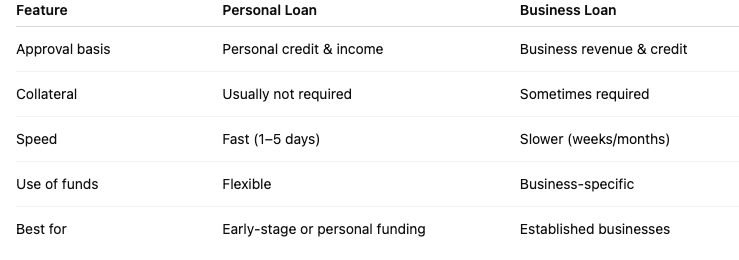
Personal Loan vs Business Loan: What’s the Difference?

What NOT to Do With a Personal Loan
Many borrowers make costly mistakes that affect long-term financial stability.
Avoid:
Using funds without a repayment plan
Mixing personal lifestyle spending with business capital
Borrowing without understanding interest costs (APR)
Ignoring monthly cash flow impact
Applying repeatedly and triggering multiple hard inquiries
Funding untested business ideas without validation
A personal loan should always be treated as structured capital, not emotional money.
What Lenders Look At Before Approving a Personal Loan
Approval is not just about credit score. Lenders evaluate:

Credit history and payment behavior
Income consistency
Employment or business stability
Debt-to-income ratio (DTI)
Recent credit inquiries
Bank account activity (in some cases)
The goal for lenders is simple:
Can you repay the loan reliably and on time?
Why People Get Denied for Personal Loans
Most denials happen for predictable reasons:
High debt-to-income ratio
Insufficient income
Poor or thin credit history
Recent late payments
Applying for the wrong lender type
Lack of documentation
Many borrowers give up after denial—but often the issue is not eligibility, it’s misalignment with the lender type.
What to Do Before You Apply for a Personal Loan
Before submitting an application, review:
Your credit profile
Your monthly income and expenses
Your repayment plan
Whether this loan supports income or growth
Whether you qualify for better funding options
Strategic borrowers don’t just apply—they position themselves first.
Next Steps
A personal loan is not just a way to access money—it’s a financial tool that can either support growth or create long-term pressure depending on how it’s used.
The difference between borrowers who struggle and entrepreneurs who scale is not access to money.
It’s strategy, timing, and structure.
Apply for Funding Support
If you're exploring funding options and want clarity on what you may qualify for, you can 👉 start here: and APPLY NOW

This helps identify funding pathways based on your current financial and business position.
