
MCA vs. Traditional Business Loans: Which One Is Right for Your Business?
When cash gets tight, business owners usually aren't asking, "What's the best financing option?"
They're asking:
"How do I make payroll?"
"How do I buy inventory before I run out?"
"How do I keep the doors open?"
That's exactly why thousands of business owners turn to Merchant Cash Advances (MCAs).
The problem isn't that MCAs exist.
The problem is that many business owners accept one without understanding how they work—or what happens if they need another one before the first is paid off.
By the way....while you're building your business, keep learning. Our YouTube channel is packed with free videos on business funding, business credit, lender requirements, and financial strategies to help you become more fundable.
If you're unsure whether your business is positioned correctly—or you've been denied
funding and don't know why—start with meeting with our advisors:Schedule consultation
NOW! Let's break this down in plain English.

What Is a Merchant Cash Advance (MCA)?
A Merchant Cash Advance isn't a traditional loan.
It's an advance against your future business revenue.
Instead of making one fixed monthly payment like a loan, the funding company takes a percentage of your daily or weekly sales until the advance has been repaid.
That makes approval faster and easier for businesses that may not qualify for bank financing.
How's an MCA Different From a Traditional Business Loan?
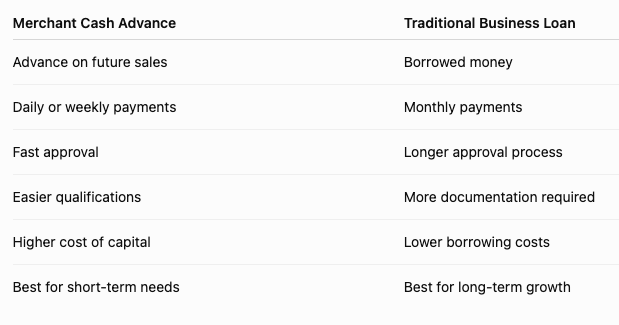
Traditional loans are generally less expensive.
MCAs are generally faster. Yet speed comes with a price.
What's a Factor Rate?
This is one of the biggest misconceptions business owners have.
Traditional loans charge interest.
Merchant Cash Advances use a factor rate.
A common factor rate ranges from 1.10 to 1.50.
Here's what that means:
If you receive $50,000 with a 1.30 factor rate, you'll repay:
$50,000 × 1.30 = $65,000
You owe the full $65,000 regardless of how quickly you repay it.
Unlike interest, paying it off early usually doesn't reduce what you owe.
That's why it's important to understand the total cost before signing.
When Does an MCA Make Sense?
An MCA can be a useful tool when it's part of a larger financial strategy.
Examples include:
Purchasing inventory before a busy season
Covering a short-term cash flow gap
Completing a project before customer payments arrive
Taking advantage of a time-sensitive business opportunity
Think of it as a bridge—not a destination.
If the funding helps generate more revenue than it costs, it may make sense.
When You Should Avoid an MCA
Don't use an MCA simply because your business is struggling.
If you don't have a plan to repay it, you're not solving the problem—you're delaying it.
An MCA should never replace fixing poor cash flow, declining sales, or unprofitable operations.
Financing should support growth, not cover ongoing losses.
NEVER Stack Merchant Cash Advances
One of the biggest mistakes we see is stacking.
Stacking happens when a business takes out a second MCA before paying off the first.
Then a third.
Sometimes even a fourth.
Each funding company starts taking payments from your revenue, leaving less cash available to actually operate your business.
That's how many businesses enter a debt spiral.
Most MCA agreements don't even allow stacking because it dramatically increases the risk of default.
If you're considering another advance just to make payments on the first one, it's time to stop and reassess your financing strategy.
What Do Banks Look for Instead?
If you qualify for traditional financing, it's almost always worth exploring first.
Many lenders review:
Business bank statements
Time in business
Monthly revenue
Business credit
Personal credit (depending on the program)
Existing debt obligations
Cash flow
Tax returns and financial statements for larger loan requests
The stronger your financial foundation, the more financing options you'll have—and the lower your cost of capital is likely to be.
Before you apply for ANY type of Financing
Preparation matters.
Before submitting an application, make sure you have:
Your business bank statements
Driver's license
Voided business check (if requested)
Business formation documents
EIN confirmation
Current debt information
Profit & Loss Statement
Balance Sheet (when applicable)
Most recent business tax returns (for many traditional loan programs)
Having your documents organized speeds up underwriting and improves your chances of approval.
The Bottom Line
A Merchant Cash Advance isn't good or bad. It's simply a financial tool.
Used correctly, it can help bridge a short-term opportunity. Used incorrectly, it can create long-term financial stress.
The goal isn't just getting approved. The goal is getting the right type of financing for your business.
Understanding your options today can save you thousands of dollars—and countless headaches—later.
Ready to Explore Your Funding Options?
Every business is different, and the right financing depends on your revenue, time in business, industry, and goals.
If you're not sure where to start, apply through our lender network. We'll help you identify financing options that fit your business—not just the ones that are easiest to sell.
While you're building your business, keep learning. Our YouTube channel is packed with free videos on business funding, business credit, lender requirements, and financial strategies to help you become more fundable.
If you're unsure whether your business is positioned correctly—or you've been denied

funding and don't know why—start with meeting with our advisors:Schedule consultation
We'll review your business profile, identify potential funding options, and help you understand what lenders are actually looking for before you apply.
Check your funding options below and speak with one of our advisors today.https://buildabusinessmethod.com/
Let's GET STARTED Click here to apply for funding.
